


For months, a clear message was circulating through Republican political circles.
Vaccine issues were becoming a liability.
As the Trump administration looked ahead to the 2026 midterm elections, strategists were reportedly urging the president to steer clear of vaccine policy and instead focus on other health priorities, alongside inflation, immigration, and the economy.
Concerns about pharmaceutical industry influence, childhood vaccine mandates and the expanding vaccine schedule were increasingly portrayed as politically risky terrain.
That narrative was reinforced by a polling memo released by Republican pollster Tony Fabrizio in late 2025, which was widely interpreted as showing that scaling back the childhood vaccine schedule was unpopular with voters.
The New York Times, for example, reported that polls indicated “Kennedy’s vaccine agenda is a dud, unpopular even with Republicans” and that the White House wanted Kennedy to downplay vaccine issues and focus instead on his more popular healthy-eating initiatives.
But there was a problem.
At roughly the same time that message was taking hold, another Fabrizio poll was telling a very different story.
According to a recent article by Daily Caller journalist Emily Kopp, Fabrizio conducted a survey in October 2025 that found widespread concern about both childhood vaccine mandates and the influence of pharmaceutical companies.
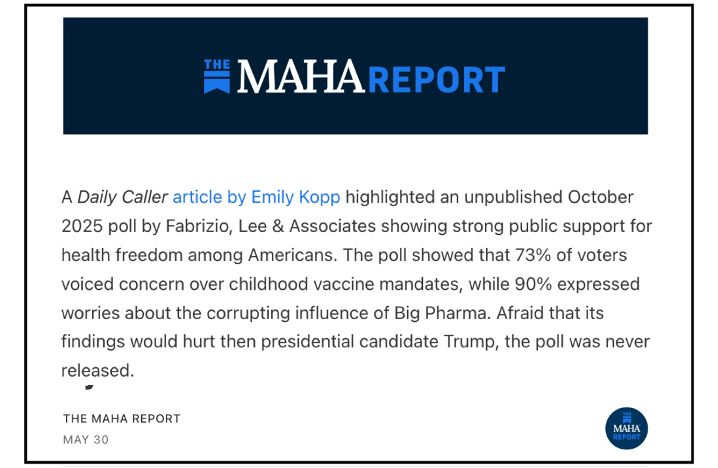
The poll reportedly found that 73% of voters were concerned about childhood vaccine mandates, while 90% expressed concern about the influence of pharmaceutical companies.
What made the findings particularly noteworthy was that Kopp reported that the survey had been commissioned by MAHA Action, the political organisation aligned with Robert F. Kennedy Jr.'s Make America Healthy Again movement.
Yet the poll was never publicly released.
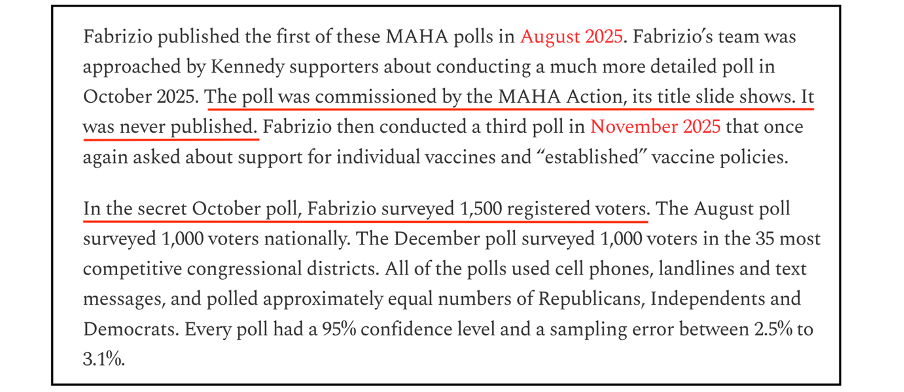
Kopp’s report on what she described as a “secret poll” immediately raised questions about whether MAHA Action had effectively buried findings that could have bolstered Kennedy’s vaccine agenda.
The story took an unexpected turn when Kopp’s article was later highlighted by The MAHA Report, a publication affiliated with MAHA Action itself.
The article acknowledged that the October survey had never been publicly released, but did not address the obvious question — why hadn’t MAHA Action released the poll.
Seeking clarification, I contacted Tony Lyons, founder of MAHA Action and president of Skyhorse Publishing.