

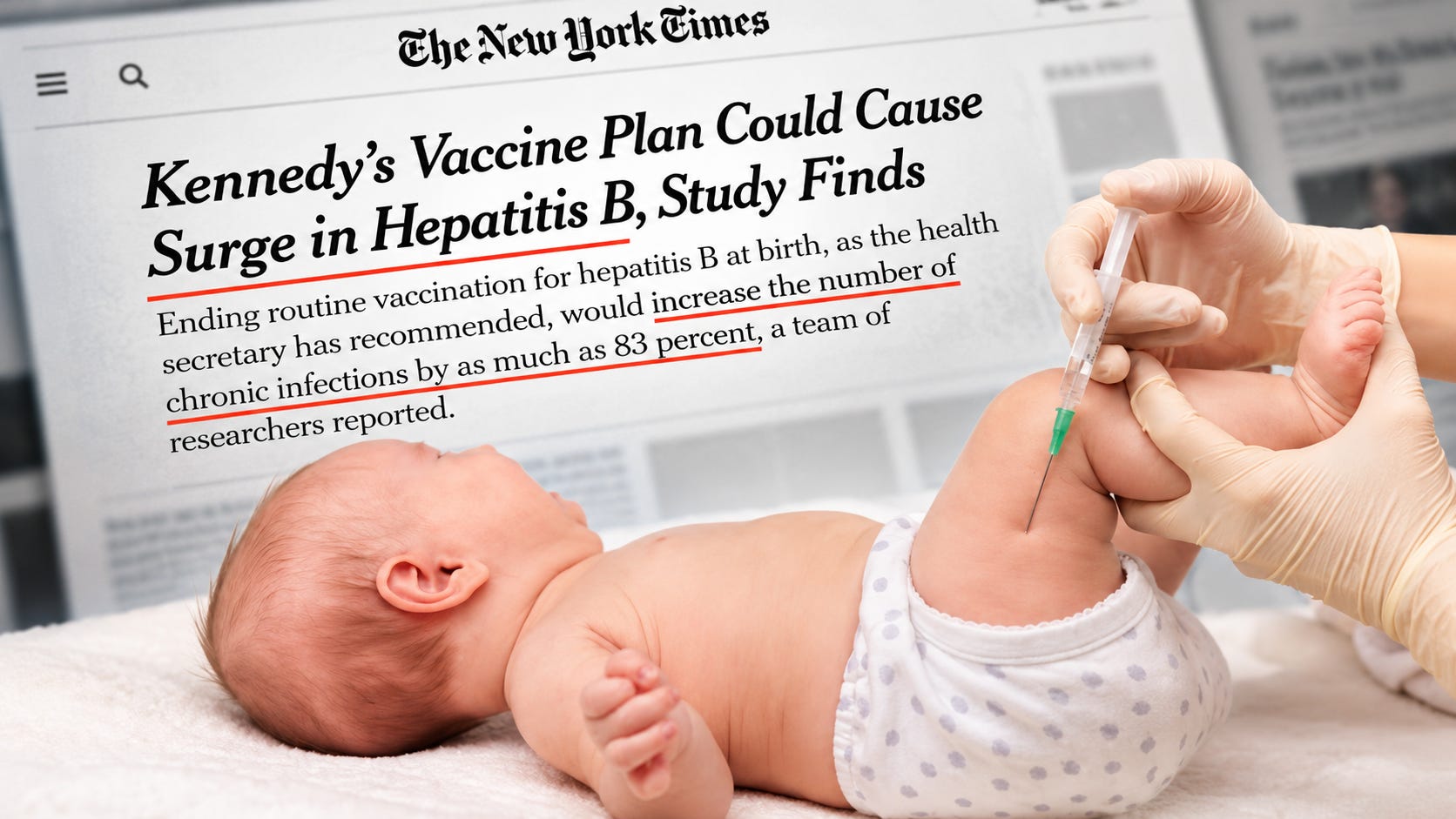
A new study published in the Annals of Internal Medicine has generated alarming headlines about the possible consequences of proposed changes to America's longstanding recommendation to vaccinate every baby against hepatitis B at birth.
Researchers from Harvard Medical School and Massachusetts General Hospital predict that allowing parents and doctors greater discretion over vaccination could increase chronic childhood hepatitis B infections by a staggering 83%.
The New York Times wasted little time amplifying the findings under the headline, “Kennedy’s Vaccine Plan Could Cause Surge in Hepatitis B, Study Finds.”
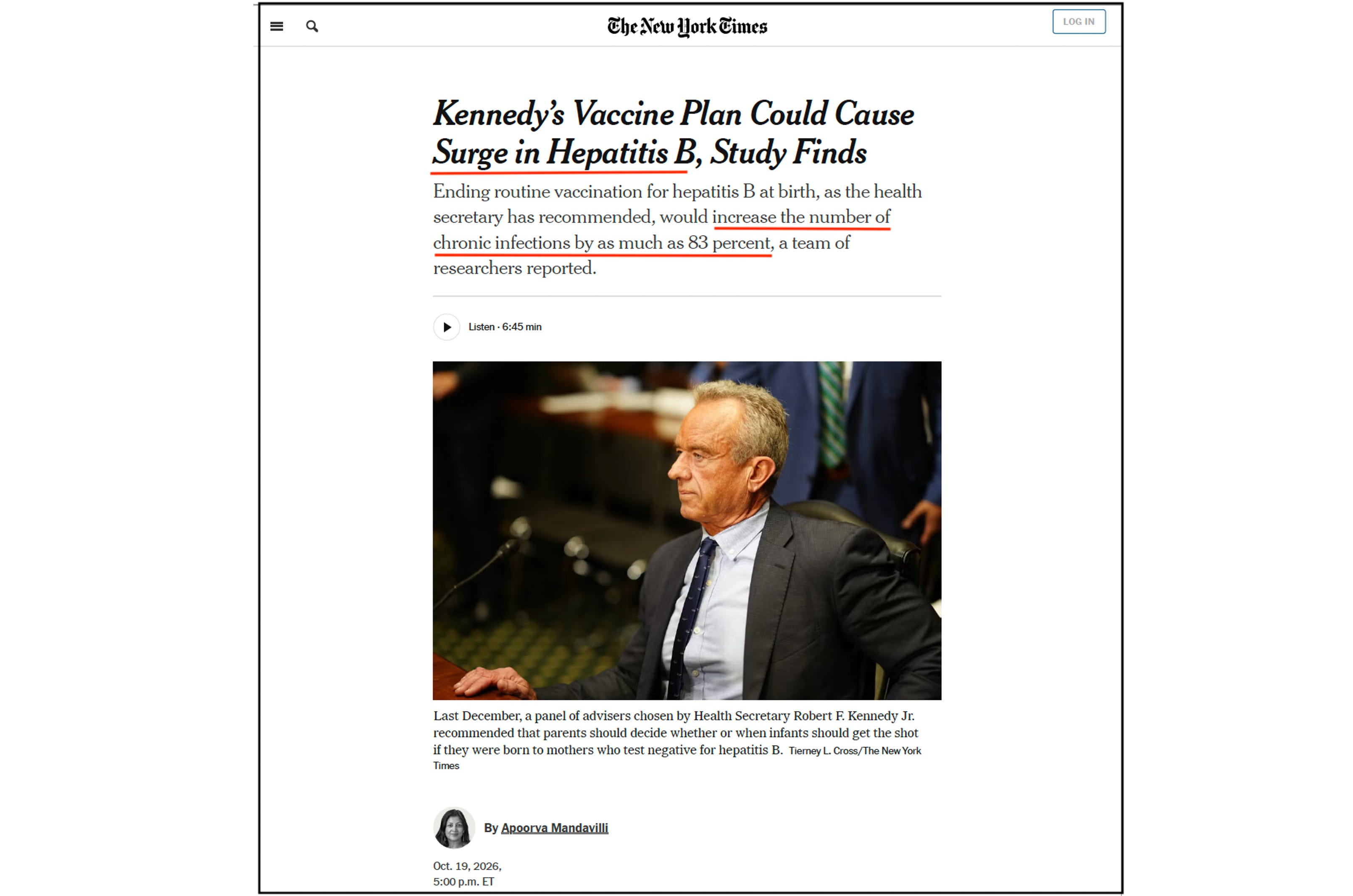
It’s a frightening statistic, but where did it come from?
The researchers did not track infections after the policy change or follow families who chose to delay vaccination. They simply ran a computer simulation built on assumptions that have never been clearly validated.
We’ve seen this before.
During Covid, mathematical models forecasting catastrophic death tolls dominated headlines and helped justify unprecedented restrictions on everyday life. Only later did serious flaws emerge in some of the assumptions underpinning those predictions.
Have we learnt nothing from those mistakes?
The 50% assumption
To arrive at their prediction, the Harvard researchers modelled what might happen to 3.6 million American children over 20 years.
After ACIP recommended shared decision-making, the researchers assumed hepatitis B vaccination completion would plunge to just 50%.
So where did that figure come from?
They borrowed uptake figures from other immunisation programmes — including a new, costly RSV monoclonal antibody that isn’t even a vaccine. Hardly a sensible comparison with a long-established hepatitis B vaccination programme.
But that unverified assumption helped produce the headline-grabbing 83% increase.
Sounds dramatic, doesn’t it? But that’s because it’s a “relative” increase.
In “absolute” terms, the model predicts just 212 additional chronic infections among 3.6 million children over 20 years — an increase in risk of approximately 0.006%.
That paints a rather different picture from the “surge” suggested by the New York Times headline.
Transmission rates built on guesswork
The researchers had to estimate how often American children might catch hepatitis B to build their mathematical model.
But in the supplementary documents, they admitted that “there is no reliable estimate” of childhood hepatitis B transmission risk in the United States.
So what did they do?
The researchers simply guessed how often American children might encounter hepatitis B, then used research from sub-Saharan Africa to estimate their chances of becoming infected. They assumed the risk of infection following exposure would be the same in both populations.
At ACIP’s December 2025 meeting, research was presented suggesting that hepatitis B transmission between people during childhood — known as horizontal transmission — was rare among most American children.
And here’s why that is so important.
Of the 212 additional chronic infections predicted by the model, 204 (or 96% of the increase) depend on precisely this kind of transmission.
In other words, almost the entire predicted surge rests on infection risks the researchers admit they cannot reliably estimate for American children.
How much confidence can anyone place in a prediction built on such uncertain assumptions?
More assumptions, more infections
The questionable assumptions didn’t end there.
The researchers modelled a scenario in which only 50.1% of babies whose mothers’ hepatitis B status was unknown received the vaccine at birth, even though ACIP had explicitly retained the birth-dose recommendation for these babies.
Where did that figure come from? An old CDC report showing that roughly half of all American newborns received hepatitis B vaccination within three days of birth in 2003–2005 — not specifically babies whose mothers’ infection status was unknown.
The researchers applied this decades-old statistic to a group still recommended for vaccination at birth, without evidence that it reflected their actual uptake.
That single assumption generated another 197 predicted chronic infections under each alternative vaccination policy.
Those infections were not part of the headline 83% increase, but they illustrate how dramatically the projections can shift when researchers change just one assumption.
What about potential harms?
There’s another fundamental question the Harvard model leaves unanswered.
The researchers estimated the benefits of universal birth-dose vaccination but did not weigh them against potential vaccine harms, instead citing existing evidence supporting vaccine safety.
The original hepatitis B vaccine safety trials were far too small to reliably detect very rare adverse events, and post-marketing surveillance has limitations of its own.
If researchers are prepared to model an absolute increase in infection risk of just 0.006% over 20 years, shouldn’t a proper risk–benefit assessment also examine potential vaccine harms occurring at similarly low frequencies?
Instead, the researchers brushed past potential harms and recommended reinstating universal birth-dose vaccination.
Where was the scrutiny?
The New York Times did little to question the study’s assumptions before amplifying its alarming findings.
It quoted the lead author, supporters of universal vaccination and a former ACIP chairman who criticised the policy change.
But not a single member of the ACIP committee that actually voted for the change was quoted. Their perspective might have exposed some of the study’s weaknesses before the story went to print.
The New York Times also overlooked an obvious real-world comparison.
Britain begins routine hepatitis B vaccination at eight weeks, while Denmark reserves it for higher-risk groups, and both have maintained low levels of childhood hepatitis B infection.
Also, in Canada, Ontario routinely vaccinates children against hepatitis B at around age 12 rather than at birth, with no documented surge in childhood infections.
These are precisely the kinds of questions and comparisons that should be examined before alarming projections are presented to the public.
Mathematical models can be useful, but their predictions are only as credible as the assumptions behind them.
When those assumptions cannot be reliably checked against real-world scenarios, presenting the results as a looming public health disaster is grossly misleading.
The Harvard study does not demonstrate that shared decision-making will cause an 83% surge in childhood hepatitis B infections. It shows how easily questionable assumptions can produce frightening predictions — and how quickly those predictions become political headlines.
[Researchers from Harvard Medical School and Massachusetts General Hospital predict that allowing parents and doctors greater discretion over vaccination could decrease the amount of money the pharmaceutical industry make by a staggering amount.]
Fixed that for you :)
The highly conditional model gets turned into “could” in the headline, “would” in the sub-headline, and on social media has probably become “Lunatic Kennedy’s killing babies!”