

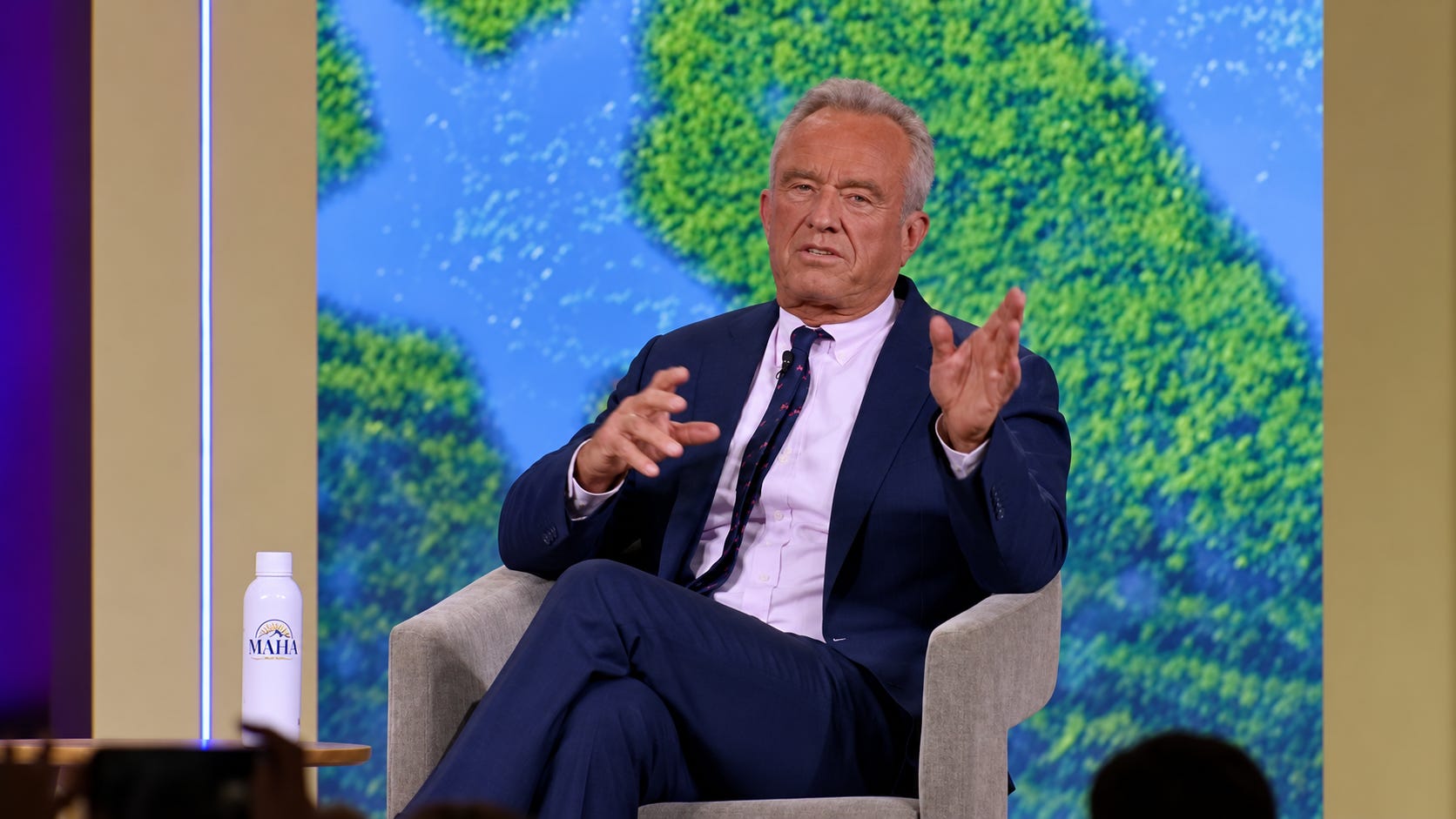
Robert F. Kennedy Jr has been talking about how artificial intelligence will revolutionise medicine.
Some of what he says I agree with. But after speaking with experts who have spent decades working with AI and healthcare data, I think some of Kennedy’s assertions warrant caution.
Speaking at the MAHA Summit in Washington DC last week, the US Health Secretary said AI could eventually give ordinary Americans access to a second medical opinion that was “much better informed than any doctor in the country.”
Kennedy argued that Americans would no longer have to be dominated by public officials telling them to “Trust the experts,” because they could verify medical advice for themselves.
He specifically pointed to officials asserting that masks work, that social distancing works, and that Covid vaccines prevent infection and transmission, suggesting “AI might correct that” and help free people from “medical tyranny.”
Others in the administration went even further, with HHS senior adviser Calley Means posting on X that it would be “medical negligence” for a doctor to give a patient advice without insisting they consult AI for a second opinion.

I often use Grok AI to search for studies, locate documents, and dig out references.
So, I asked it three simple questions on topics where Kennedy has taken firm, high-profile stances — do vaccines cause autism? Is fluoridation of the public water supply harmful? And does Wi-Fi cause cancer?
In each case, Grok essentially returned the establishment consensus. It stated that there was “no causal link” between vaccines and autism, that fluoridation “does not cause serious harm,” and that “Wi-Fi exposure had no established link to cancer.”
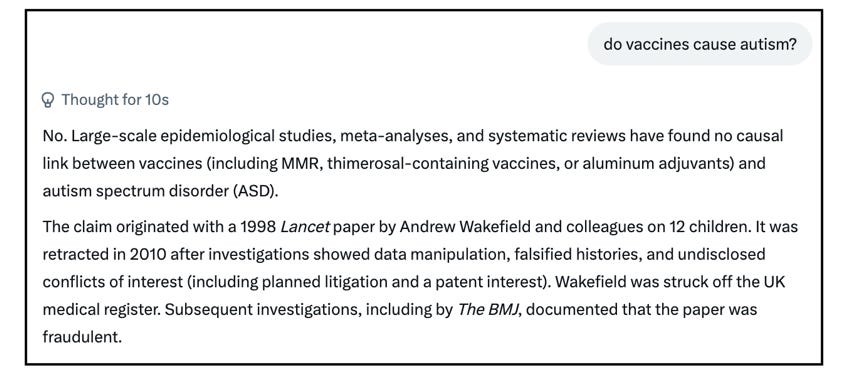
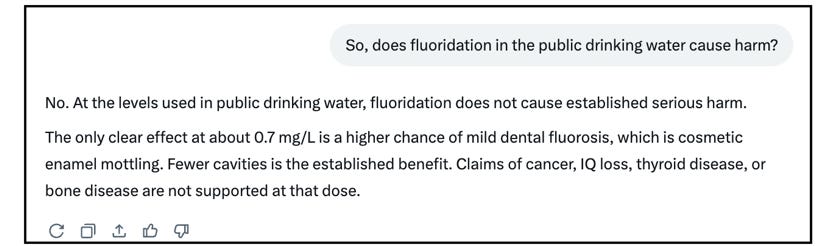

Those answers directly contradict Kennedy’s own public declarations.
In a 2023 Fox News interview, he said “I do believe that autism does come from vaccines.” In November 2024, he announced that a Trump administration would “advise all U.S. water systems to remove fluoride from public water.” And on Joe Rogan’s podcast, Kennedy claimed that Wi-Fi radiation “does all kinds of bad things, including causing cancer.”
Asking Grok these questions doesn’t resolve any of those scientific debates, but my point is much simpler. Kennedy claims we no longer have to blindly trust experts because we can ask AI instead.
So what happens when AI hands you the exact same answers as the medical establishment Kennedy has spent years challenging? Whose “second opinion” are we actually receiving?
AI can be captured
AI cannot escape the institutional capture that already shapes much of the medical evidence on which it relies.
A central focus of my investigative work as a medical journalist has been examining how pharmaceutical money can influence the evidence base, regulatory decisions, medical publishing, and the clinical guidelines that ultimately shape prescribing.
Kennedy has spent decades challenging many of those same institutions, which is precisely why his suggestion that AI can liberate patients from medical authority warrants scepticism.
AI does not possess an independent repository of medical truth.
Its answers are built entirely from human-generated information — published clinical trials, medical journals, treatment guidelines, regulatory filings, textbooks, professional society statements, and wider online data. And that evidence base is far from neutral.
I have reported on numerous instances where guidelines become remarkably “pharma-friendly,” where uncomfortable trial results struggle to get peer-reviewed, where researchers are denied access to raw patient data, and where institutional consensus becomes nearly impossible to challenge.
AI does not make those problems disappear. If an adverse event was never documented in a dataset, AI cannot retrieve it. If a clinical trial was designed around the wrong question, AI cannot redesign it after the fact. If an underlying guideline reflects a distorted evidence base, AI may simply reproduce that recommendation.
So, replacing “Trust the experts” with “Ask AI” doesn’t resolve the underlying problem of capture.
How does AI handle your medical record?
Kennedy also claims AI will save your doctor time by reviewing medical records.
“You may have a medical record that is a thousand pages long,” he said. “You have six minutes with a doctor today. He is not gonna be able to review it, but the AI can.”
On the surface, having a machine review 1,000 pages of health history and spot details a rushed doctor might miss sounds ideal. But that assumes AI can accurately interpret what it is reading. It doesn’t always.
Electronic health records are often fragmented — scattered across multiple healthcare databases. They can contain outdated medication lists, contradictory information, and errors carried forward from earlier notes.
One medical data expert who works on this issue daily described generative-AI summaries of patient records as “scarily discrepant,” noting that feeding the same patient record into the same AI model can produce noticeably different summaries across separate runs.
AI might be able to process 1,000 pages in seconds, but it cannot easily determine whether a listed diagnosis is active or outdated, resolve contradictory entries, distinguish a billing code from a genuine diagnosis, or identify what was left out entirely.
Put simply, reading a medical record is not the same as understanding it — and getting that distinction wrong can lead to inappropriate treatment for the patient.
AI can save your doctor time
Doctors are increasingly using what they call “ambient AI scribes” — programs that listen to a consultation and generate clinical notes in real time.
I recently accompanied one of my parents to a consultation where an ambient AI scribe was being used, and I could see its immediate value.
It saved the doctor time and allowed them to focus on the patient rather than staring at a computer screen and typing notes.
Doctors seem to like them too. A multicentre study of 263 clinicians found that after 30 days of using an ambient AI scribe, doctors reported a reduced documentation burden and greater focus on their patients.
But there’s a catch.
The AI-generated note may itself contain inaccuracies, fabrications, and important omissions.
A recent study comparing five ambient scribe platforms found that, on average, 26% of key clinical information was either omitted or recorded incorrectly, with an average of three errors per case carrying the potential for moderate-to-severe harm.
So, while AI scribes may genuinely save doctors time, their output still needs to be carefully checked. Otherwise, errors can become part of the patient’s medical record.
As one expert told me, “Generative AI cannot be used to check generative AI.”
There is also a financial incentive at play.
In the US, doctors and hospitals are paid more for some visits when the medical decision-making is more complex. A more detailed AI-generated note can help clinicians or billing staff justify a higher-paying billing code.
Researchers have warned that ambient AI scribes are increasing coding intensity and reimbursement, making higher billing part of the core business case for these products.
AI has a place in medicine
Medical imaging is one area where AI can provide a valuable second set of eyes — and some believe it could eventually replace at least some of the work radiologists do.
In a 2024 study of chest CT scans, AI assistance increased pulmonary nodule detection among radiology residents from 64% to 77%.
AI has also shown promise in cardiology. In a 2024 study, a machine-learning system interpreting stress-test data outperformed cardiologists at predicting clinically significant coronary artery disease.
But medicine is more than recognising patterns in data.
A skilled doctor can examine you, notice your gait as you walk into the room, spot a suspicious mole, or offer genuine empathy and compassion — things AI cannot do.
But with doctors spending so much of their time staring at screens, completing paperwork and meeting quotas, there is less time for individualised care.
AI may free up some of that time by reducing administrative work and supporting specific diagnostic tasks, but it should not become another authority we are expected to trust unquestioningly.
The answer to “don’t blindly trust the experts” cannot simply be “blindly trust the algorithm.”
Nice article.
But so much more can be said.
I use AI scribe in my medical practice. It allows me to spend more time interacting with the patient and allows a better summary to be sent to patient who then retains more from the visit. But I don’t think I or anyone knows whether AI misses less or more necessary info than if I wrote the entire note while trying to stay engaged with the patient in front of me.
Next- MAHA has been captured by those in power in the White House who are yet again siding with Wall Street over Main Street. Me thinks this is another attack on healthcare professionals to herd them into whatever system they have in store as opposed to allowing a true fair free market in healthcare form.
FYI- I terminated all contracts with third parties in my practice back in 2008. I do not get paid a cent from insurers or government. My practice is thriving while patients pay me a fair fee for care they value. Their choice to see me. Not herded to my office by third parties.
But back to AI. It’s as good as it is programmed. It’s in essence a slightly better search engine that helps with grammar at this point. It will improve, but will the definition of improve be helping people think, or instead herding them to where the govt or third parties are trying to steer us?
Maryanne, Brilliant as usual. The consensus (which is all that generative AI can deliver) may be true or not for someone somewhere -- but not necessarily for YOU, and that is the point of health care. Kudos.