

For years, clinicians and patients have described a disturbing pattern — cancers appearing suddenly, growing at unexpected speed, or diseases thought stable returning aggressively within weeks or months.
Some called them “turbo cancers”. In oncology, the phenomenon is known as hyper-progression: cancers that accelerate far more rapidly than expected.
Early on, these reports were ignored. They surfaced as scattered cases — isolated anecdotes that were easy to dismiss.
One of the first to speak publicly was Belgian immunologist Michel Goldman, whose story was published in The Atlantic in 2022. He believed the Covid-19 vaccine may have accelerated his lymphoma.
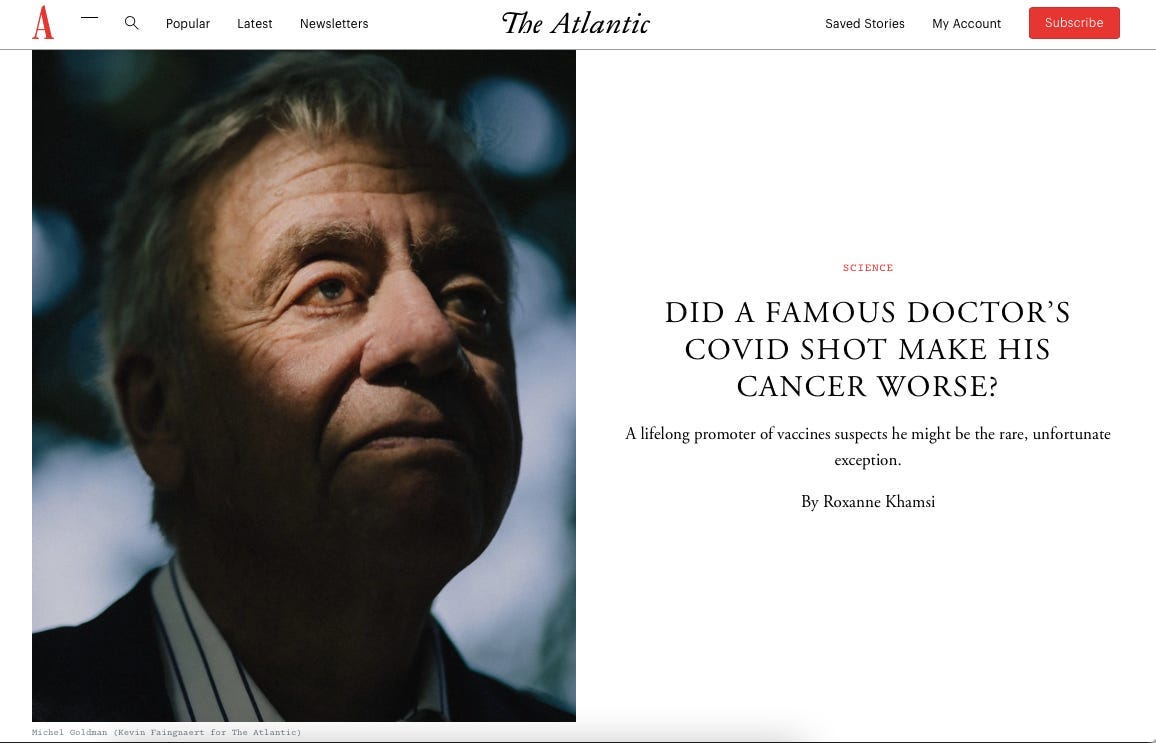
Shortly after vaccination and boosting, he developed swollen lymph nodes, fatigue and night sweats. Imaging revealed widespread new cancer clusters, which he said looked “like someone had set off fireworks inside his body.”
The backlash was immediate.
Haematologist-oncologist Vinay Prasad condemned the reporting as “irresponsible,” arguing that case reports were not evidence and that epidemiological data were required before such concerns should even be raised.
But patients and clinicians continued to describe cancers that progressed rapidly, relapsed early, or behaved in ways that defied expectations. That left a question that had never been resolved…
Could Covid-19 vaccination or infection, in rare susceptible individuals, accelerate the growth of cancer?
Now, three years later, the evidence critics demanded has begun to emerge.
A peer-reviewed paper published in Oncotarget has pulled these fragmented observations into a single, systematic analysis.
The study is authored by senior cancer researchers Charlotte Kuperwasser and Wafik El-Deiry — both respected figures in cancer biology, and both members of the Covid-19 vaccine workgroup advising the CDC’s Advisory Committee on Immunisation Practices.

The authors do not claim that Covid-19 vaccines cause cancer. Temporal association does not prove causation.
But they do argue that once patterns of unusually aggressive cancers recur often enough — across continents, cancer types and vaccine platforms — continued dismissal becomes scientifically indefensible.
Speaking to MD Reports, senior author Professor El-Deiry said the paper crystallises years of unresolved concerns — including how critical safety questions were repeatedly set aside before vaccine rollout.