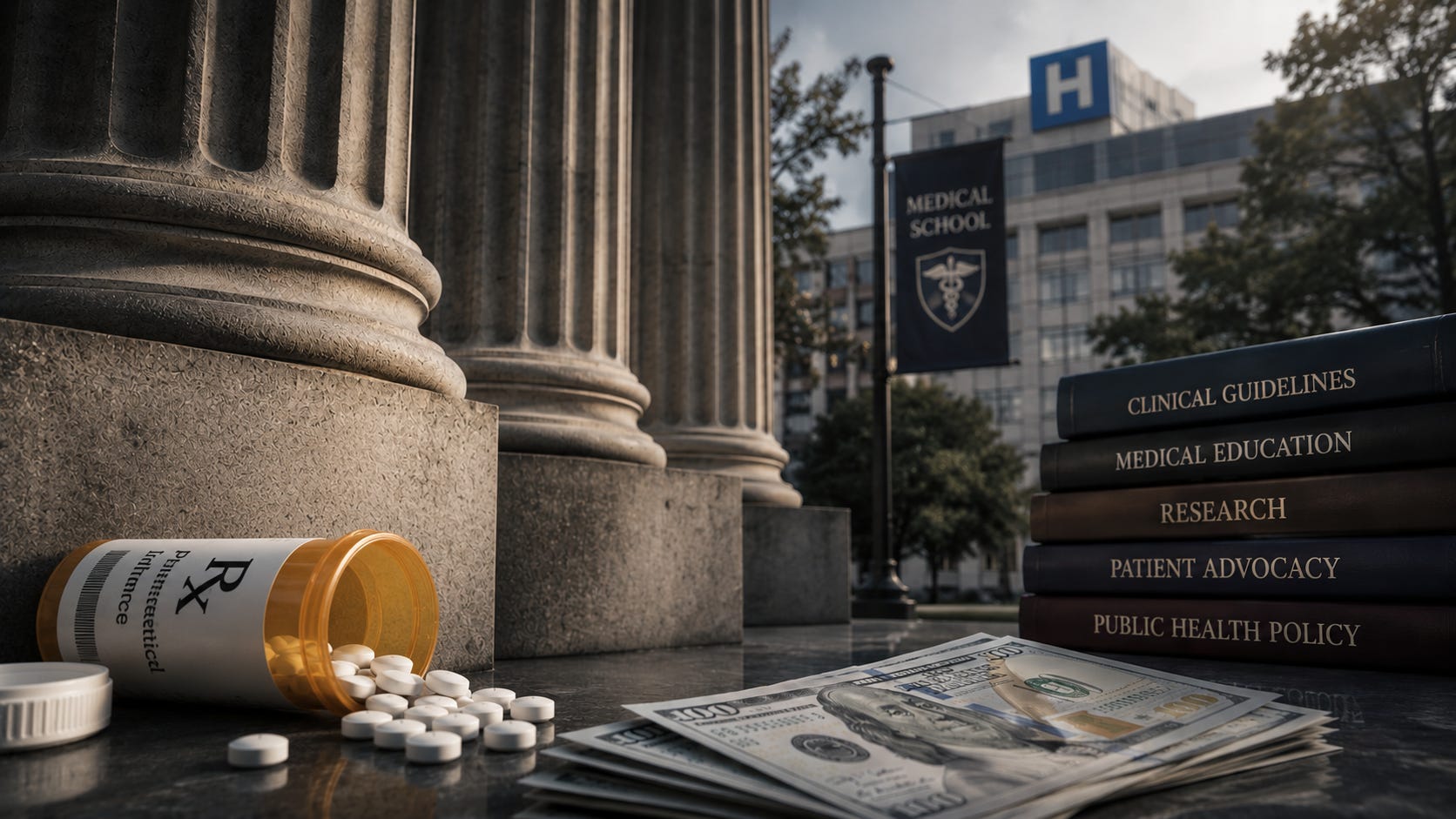
The old pharmaceutical bribe was easy to recognise. Drug company reps flew doctors to luxury resorts, paid for lavish dinners, disguised kickbacks as consulting fees, and funded educational events that were little more than sales pitches.
A recent academic review published in the Journal of Law, Medicine & Ethics examined over two decades of bribery cases, uncovering repeated patterns of sham consulting contracts, fake educational events, luxury travel, and hidden payments.
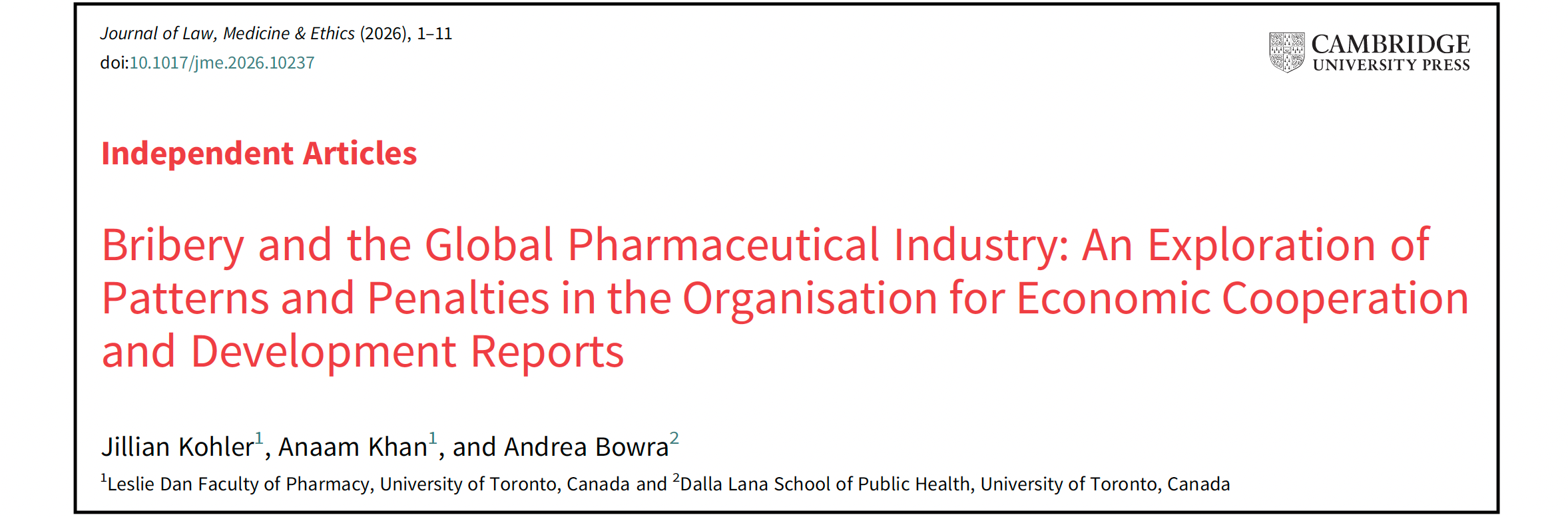
The U.S. Department of Justice has repeatedly prosecuted industry giants—Pfizer, Merck, GlaxoSmithKline, Johnson & Johnson, Eli Lilly, and Purdue Pharma—resulting collectively in tens of billions of dollars in settlements and penalties.
Yet despite decades of high-profile prosecutions, Big Pharma’s influence over medicine has not disappeared — it has simply evolved.
Governments attempted to curb this direct-to-physician influence through transparency laws. The U.S. Sunshine Act, passed in 2010, forced companies to disclose payments to doctors via the Open Payments database.
The theory was that exposure would deter or constrain these relationships, but the sums disclosed remain enormous and there is little evidence that transparency alone has substantially changed industry or physician behaviour.
In 2023, payments and transfers of value to US physicians totalled US$3.93 billion for direct research, consulting, speaking fees, meals, travel, and investment interests.
These individual-level incentives remain remarkably effective.
One analysis of payments to physicians prescribing diabetes drugs estimated that every dollar received generated roughly US$30 in additional drug costs through increased prescribing of branded medicines.
But influencing individual doctors is now only part of the strategy. The real evolution has been the movement of pharmaceutical money further upstream.
Today, pharmaceutical funding underwrites the very institutions that generate medical evidence, shape clinical standards, and guide public policy — universities, teaching hospitals, medical journals, research institutes, continuing medical education providers, professional societies, guideline panels, and patient advocacy groups.
Instead of paying a doctor to choose a drug, the modern strategy endows academic chairs, funds research centres, sponsors national conferences, and staffs advisory boards.
This form of influence is more discreet than an envelope of cash, but infinitely more powerful.
It builds careers and elevates aligned experts. In this ecosystem, certain research ideas receive priority funding, industry-friendly experts become household names, and clinical guidelines shift—often without anyone ever explicitly asking for a favourable conclusion.
This institutional capture now spans every corner of healthcare, starting with patient advocacy groups. Widely viewed as independent patient champions, many of these groups rely heavily on industry funding.
Studies show that patient advocacy organisations receiving financial support from opioid manufacturers were significantly more likely to oppose guidelines restricting opioid prescribing.
Similarly, a Public Citizen analysis revealed that 75% of groups campaigning against Medicare drug-pricing reforms had direct financial ties to the pharmaceutical industry.
Continuing medical education has become another critical channel of influence. Doctors are required to complete ongoing training to maintain their licences, yet much of it is bankrolled by industry.
A BMJ investigation found that 72% of leaders across 10 major medical associations had financial ties to the pharmaceutical industry.
The dependence is so deeply ingrained that when the College of Family Physicians of Canada attempted to transition to pharma-free education, financial strain forced it to backtrack.
More recently, this incentive structure has been built directly into the delivery of medical care itself.
During the pandemic, Anthem Blue Cross and Blue Shield Medicaid introduced a Covid-19 Vaccine Provider Incentive Program in Kentucky, offering clinics escalating bonuses based on patient vaccination rates.
Clinics reaching a 75% threshold were eligible for up to US$250 per newly vaccinated member, allowing larger practices to receive hundreds of thousands—and in some cases nearly a million—dollars.
U.S. Health Secretary Robert F. Kennedy Jr. has repeatedly argued that financial incentives embedded throughout healthcare systems distort medical decision-making.
In a public statement last year, Kennedy criticised reimbursement systems that rewarded hospitals and physicians for meeting pharmaceutical and vaccination-related targets.
“Doctors are being paid to vaccinate, not to evaluate,” he said bluntly.
Most physicians genuinely believe they are practising independently because modern incentives bear no resemblance to old-school bribes like luxury holidays or hidden kickbacks. But modern pharmaceutical influence is far more sophisticated.
By embedding itself into the architecture of medical education, research, and institutional policy, it no longer needs to buy a doctor’s loyalty—it shapes the very reality in which doctors practise.
And that is precisely what makes this new era of Big Pharma influence so durable and so difficult to dismantle.


ROTTEN - To The Core 🪱
Nice but you left out two even bigger and more Influential Industries BigHarma has captured.
1- Politicians via campaign financing contributions
2- Traditional media via advertising dollars
People hear more from those two than the medical establishment.