Anthony Fauci returns to Capitol Hill on July 29 to face fresh questions about the origins of Covid-19 and his role in the pandemic.
For years, Fauci has denied that the National Institutes of Health (NIH) funded gain-of-function research in Wuhan and repeatedly claimed not to recall critical early decisions.
During his January 2024 interview with the House Select Subcommittee on the Coronavirus Pandemic, lawmakers counted over 100 instances where he answered, “I don’t recall.”
Now, Senator Rand Paul has released more than 1,000 pages of Fauci's private diary, spanning from December 2019 until his retirement at the end of 2022.
Written contemporaneously and never intended for public release, the pages detail key meetings, phone calls, scientific debates, and personal observations as the crisis unfolded.
For the first time, Fauci’s public narrative can be measured directly against his private record.
The initial warning
By late January 2020, the official explanation for the outbreak was already collapsing behind closed doors.
On January 26, Fauci recorded that epidemiological and genomic data indicated the earliest infections occurred weeks before the cluster at Wuhan’s Huanan Seafood Market.
His takeaway was unambiguous: “The market was not the source, it was the amplifier.”

That was a remarkable observation. The seafood market was central to the official outbreak narrative. If it was merely an amplifier, the virus had to have originated elsewhere.
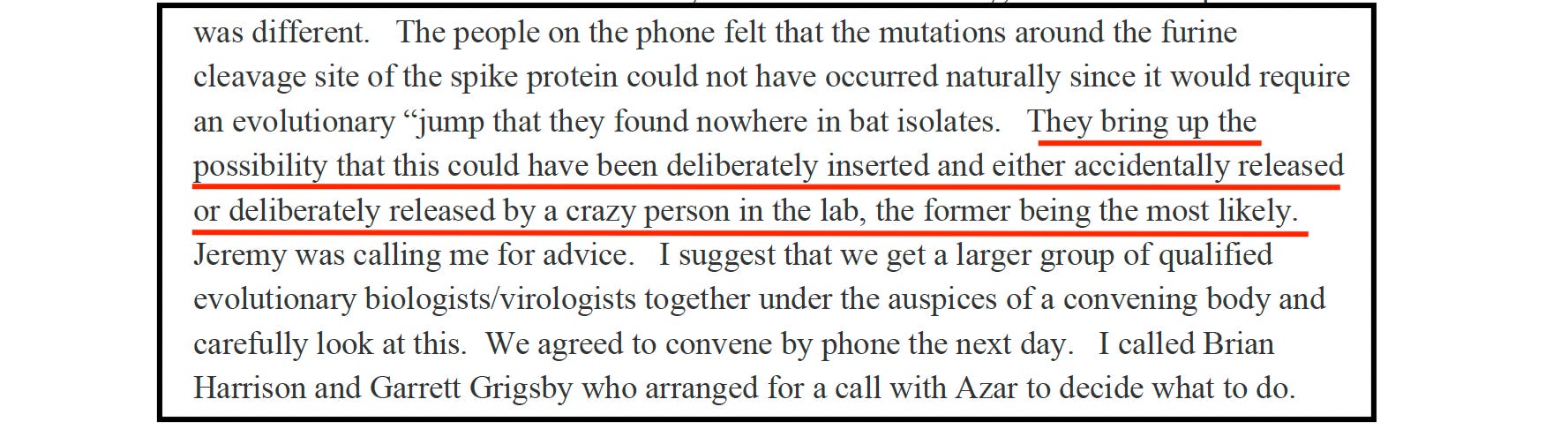
Five days later, on January 31, Jeremy Farrar telephoned Fauci after consulting scientists Kristian Andersen, Eddie Holmes, and Bob Garry about the newly sequenced SARS-CoV-2 genome.
Fauci noted that the scientists found the genome “inconsistent with expectations from evolutionary theory,” focusing specifically on the virus’s furin cleavage site, which “could not have occurred naturally.”
He then noted:
“They bring up the possibility that this could have been deliberately inserted and either accidentally released or deliberately released by a crazy person in the lab—the former being the most likely.”