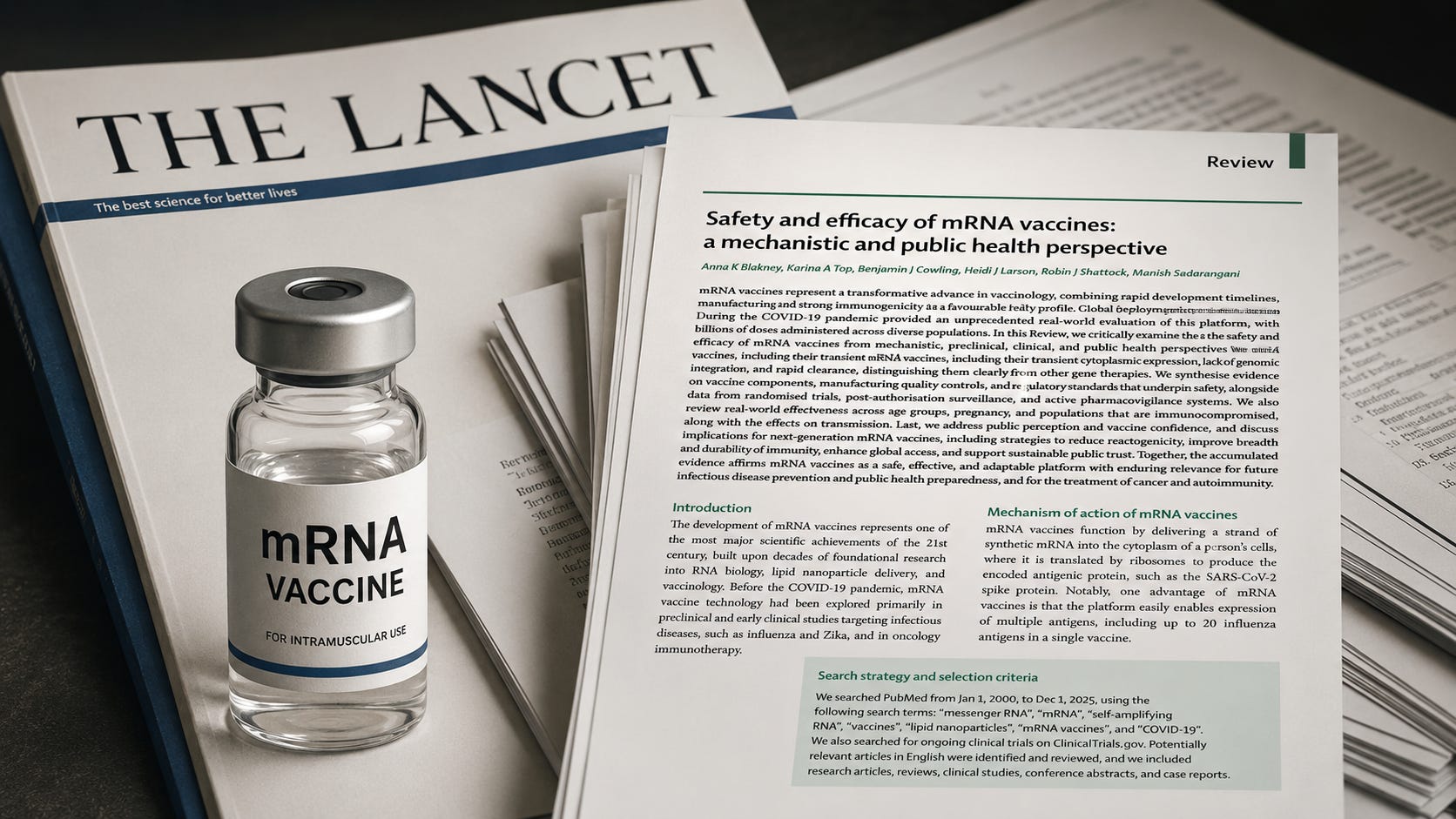
The Lancet's latest mRNA review reads more like marketing than science
The authors call mRNA vaccines safe, effective & transformative. But the review is largely performative. It raises controversial questions only to defuse them with reassuring conclusions.
The Lancet’s latest review of mRNA vaccines, by Blakney and colleagues, presents itself as an authoritative synthesis of the evidence.
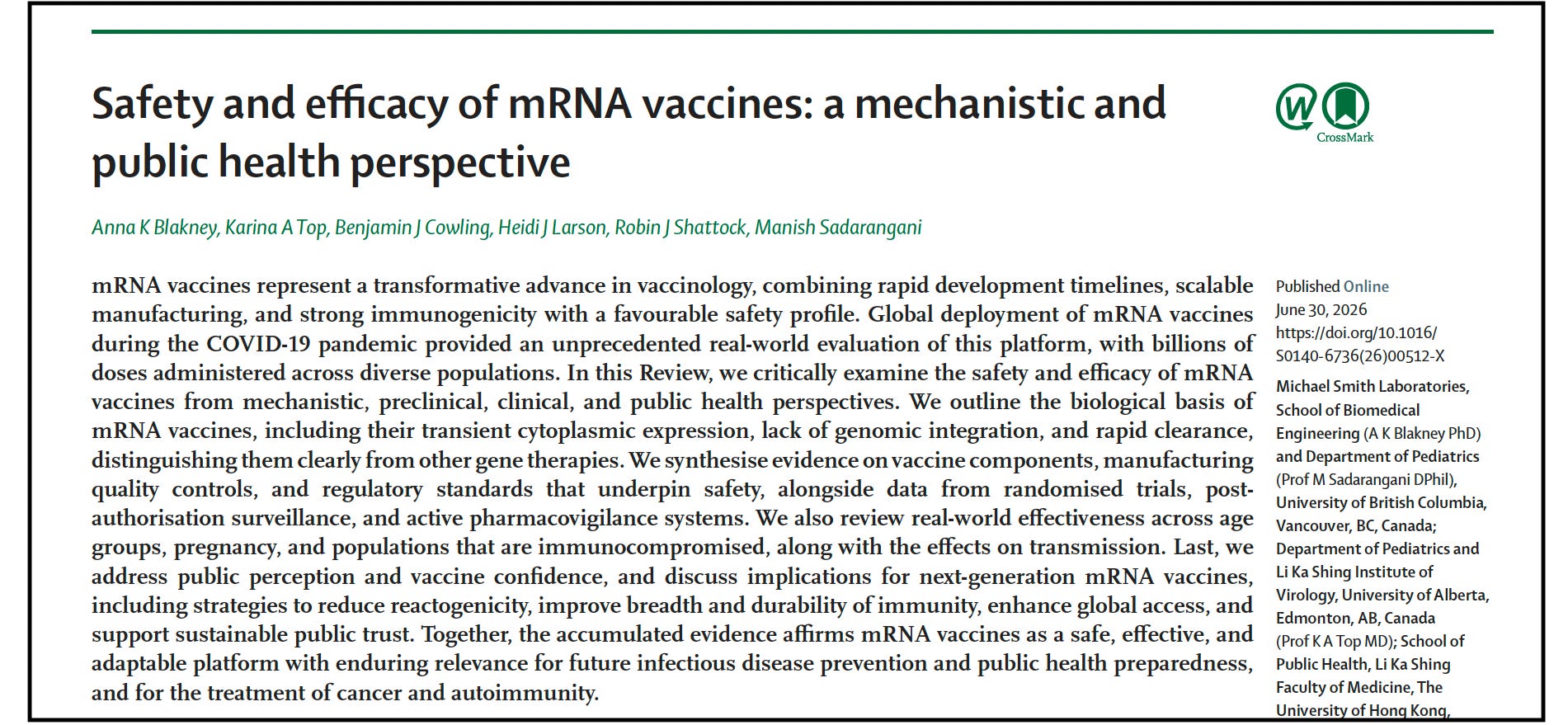
Titled “Safety and efficacy of mRNA vaccines: a mechanistic and public health perspective,” it promises to examine the mRNA platform from mechanistic, preclinical, clinical and public health perspectives.
Instead, it delivers a remarkably confident account that gives little attention to many of the scientific and regulatory questions that have shaped debate over the past five years.
What makes the review effective as messaging is not that it ignores controversy, but that it appears to engage with it.
It names difficult issues — residual DNA, biodistribution, frameshifting and IgG4 class switching — only to swiftly minimise them with reassuring language.
The effect is to create the appearance of critical scrutiny while reassuring readers that these concerns are either resolved or insignificant.
The review describes mRNA vaccines as a “transformative advance” characterised by “rapid clearance,” “lack of genomic integration,” and a “favourable safety profile.” It concludes that the accumulated evidence “affirms” the platform as safe, effective and adaptable.
Ironically, the review sits behind a paywall. Most journalists will never read it, many doctors will see only the abstract, and policymakers are likely to rely on its conclusions without examining the evidence in detail.
Having spent more than five years examining regulatory decisions, FOI documents, advisory committee meetings and independent laboratory findings on mRNA vaccines, I expected the review to grapple with the questions that repeatedly emerged during those investigations. But it didn’t.
The authors note that after injection, mRNA lipid nanoparticles “remain largely localised to the injection site” with “limited distribution” to secondary organs. The review also notes that vaccine mRNA has been detected in human plasma for up to 14 days in some recipients, and that mRNA and spike antigen have been found in draining lymph nodes for up to 60 days.
But these findings are quickly reframed as evidence of “rapid clearance” and “short-lived antigen expression” — a conclusion presented with far greater confidence than the underlying evidence appears to warrant.
Only last year, members of the CDC’s vaccine advisory committee questioned the manufacturers after discovering that biodistribution studies had never been conducted using the commercial vaccine administered to millions of people.
When asked directly whether those studies had been performed, company representatives struggled to answer, exposing important gaps in the evidence base. Yet those gaps receive little attention in the review.
Residual DNA is treated similarly.
The authors state that residual DNA is “routinely quantified,” that regulatory standards require less than 10 nanograms per dose, and that independent analyses have confirmed commercial vaccines comply with those limits.
This creates the impression that the matter has been properly examined when, in reality, the review bypasses the central scientific questions.
Were the analytical methods capable of measuring DNA encapsulated within lipid nanoparticles? Were all relevant plasmid sequences — including SV40 regulatory elements — fully characterised? Was genomic integration ever adequately investigated?
I have previously reported that regulators relied on a qPCR assay targeting only a small section of the plasmid — an approach independent scientists argue was never designed to detect the contamination now under debate.
Rather than examining those methodological criticisms, the review proceeds as though the matter has already been settled.
The review briefly acknowledges another emerging issue — that N1-methylpseudouridine can produce ribosomal frameshifting and off-target proteins — but quickly reassures readers that no adverse outcomes have yet been linked to the phenomenon.
This is technically correct — there are no large-scale studies that have specifically investigated whether these off-target proteins contribute to vaccine-related injuries. But the absence of evidence is interpreted as evidence of absence.
The same pattern appears in the discussion of vaccine safety.
The authors state that adverse events have been “rigorously monitored” through passive and active surveillance systems.
But those same surveillance systems have frequently been dismissed by many of the same academics whenever independent researchers identified potential safety signals.
The review also ignores the regulatory controversies that unfolded last year after internal FDA investigations identified child deaths caused by Covid-19 vaccination.
Former FDA Commissioner Marty Makary publicly acknowledged those deaths, and internal disagreements over the agency’s handling became the subject of Congressional scrutiny.
The authors recognise myocarditis as a vaccine-associated adverse event and acknowledge that some patients continue to experience symptoms or imaging abnormalities more than twelve months later. But the discussion ends almost as soon as it begins.
There is no consideration of what persistent myocardial injury might mean over decades of follow-up, particularly in younger people, nor any serious examination of whether repeated boosting altered the overall risk-benefit balance in low-risk populations.
Instead, the review quickly returns to the familiar conclusion that the risk from SARS-CoV-2 infection outweighs the risk from vaccination.
On the topic of transmission, the review acknowledges that mRNA vaccines do not induce sterilising immunity and that household studies show only modest reductions in transmission.
But there is no meaningful reflection on the extraordinary public messaging that vaccination would protect others and stop transmission — the claim that became one of the principal justifications for vaccine mandates.
The authors also briefly discuss the shift towards IgG4 antibodies following repeated mRNA vaccination before concluding that the clinical significance remains “uncertain.” That is true, but only because the issue remains under-investigated.
Researchers continue to examine whether repeated exposure to the same antigen influences immune responses through mechanisms such as immune imprinting and antibody subclass switching. These are not settled questions.
The authors’ conflict-of-interest disclosures are also difficult to ignore.
Collectively, they disclose advisory roles, consultancy work, research funding and other professional relationships with Pfizer, Moderna, GSK, Sanofi, Novavax, CEPI, the Gates Foundation and other organisations that have played central roles in developing, funding and promoting the mRNA platform.
When authors maintain ties to organisations with a stake in that field, readers are entitled to ask whether the evidence has been weighed impartially.
That question becomes even more important in the authors’ discussion of public trust. They attribute declining confidence primarily to misinformation, politicisation and the amplification of perceived risk.
But there is little acknowledgement of the damage caused by overconfident public messaging, coercive mandates, delayed acknowledgement of genuine adverse events, resistance to sharing underlying data, or the repeated dismissal of legitimate scientific questions.
Trust is not rebuilt by telling the public they misunderstood the science. It is rebuilt by acknowledging where the evidence was uncertain, where regulators got things wrong, and where important questions remain unanswered.
In my view, one of the world’s most influential medical journals has published a review that is largely performative. It raises controversial questions only long enough to defuse them with reassuring conclusions.
At best, it reads like marketing. At worst, it’s propaganda.
And because it carries the imprimatur of The Lancet, many readers will mistake it for scientific consensus.


Ahh "The Lancet" !
...more material to line the cat litter box 🐈 🤣
The Lancet hits a new low. Like the title of the book, its new name should be "Science for Sale".