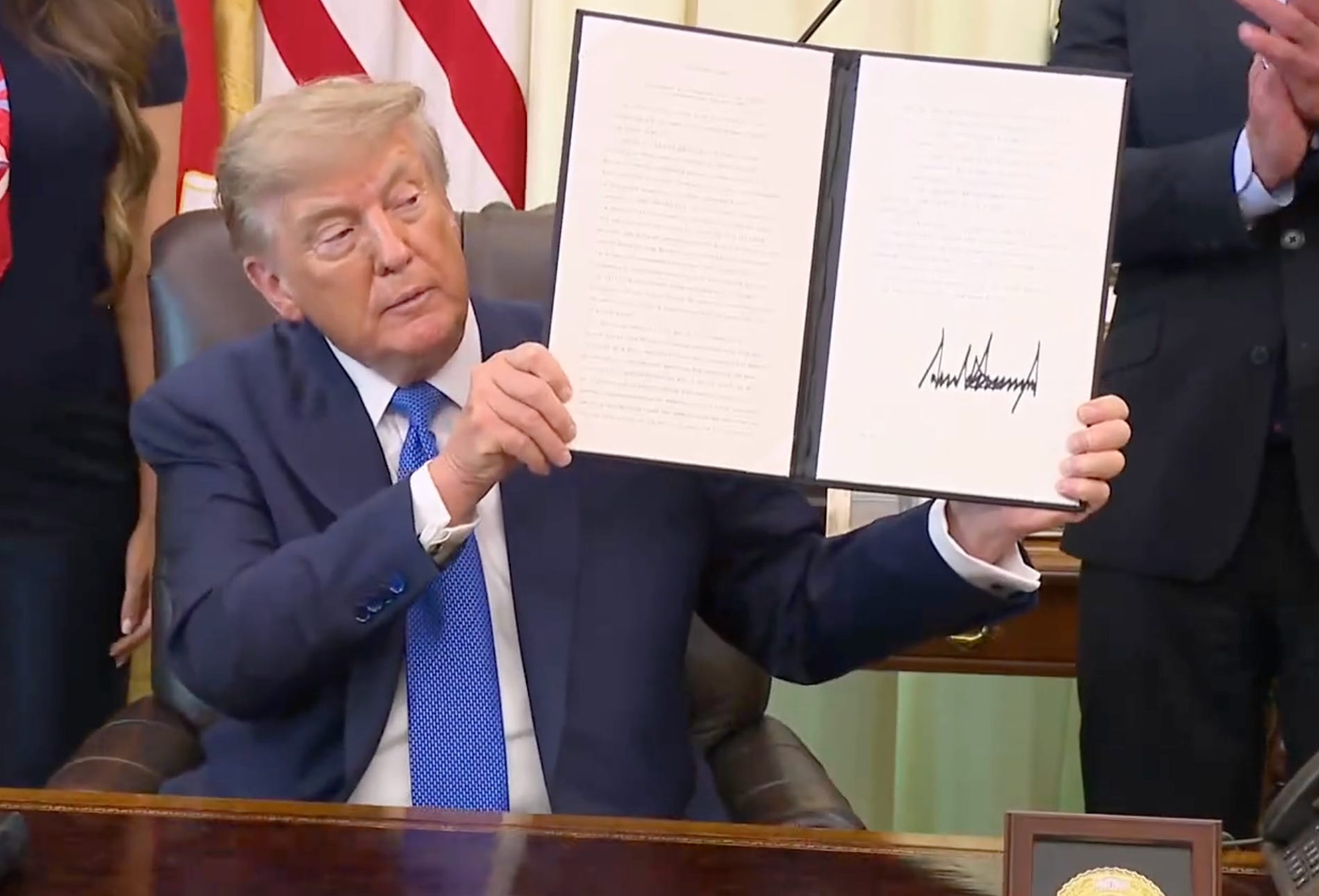
Trump doubles down on vaccine reform
Despite repeated claims that vaccines had become politically toxic, Trump is pushing ahead with his most ambitious vaccine reforms yet.
With the midterm elections approaching, reports have repeatedly suggested President Donald Trump was being urged to retreat from vaccine reform.
Robert F. Kennedy Jr.’s agenda was said to be politically toxic, with Republican strategists reportedly wanting the administration focused instead on food, chronic disease and the economy.
Much of that narrative rested on polling by Trump’s longtime pollster Tony Fabrizio, widely interpreted as showing Kennedy’s vaccine agenda was a political loser.
But the polling was never the whole story.
As I previously reported, journalist Emily Kopp revealed that another Fabrizio survey—commissioned by MAHA Action last October—found 73% of voters concerned about vaccine mandates and 90% about pharmaceutical industry influence.
A separate Zogby Strategies survey, released by the Brownstone Institute and Health Freedom Defense Fund, produced a similar picture, finding strong support for informed consent and opposition to medical mandates.
So has Trump changed political strategy? Were his advisers misreading the electorate? Or has he simply decided vaccines are an issue on which he is prepared to absorb the political cost?
I don’t know for certain, but Trump’s scepticism about vaccination is longstanding.
During his 2015 presidential campaign, he recounted the story of a child he knew who he said developed profound autism following vaccination. Whatever you make of the anecdote, Trump clearly came to the presidency with deeply entrenched concerns about vaccines.
Those instincts were on full display at his White House autism press conference last September.
Trump argued that babies were receiving too many vaccines at once, urged parents to spread out their children’s shots and called for the measles, mumps and rubella (MMR) vaccines to be administered separately.
“The MMR, I think should be taken separately,” he said. “When you mix them, there could be a problem. So there’s no downside in taking them separately.”
He compared giving babies multiple vaccines at once to “shooting up a horse” and appeared unfazed by the political consequences.
“When you talk about vaccines, it’s crazy… I don’t care about being attacked,” Trump said.
Since then, the administration has repeatedly tried to translate those instincts into policy.
Kennedy replaced the CDC’s vaccine advisory committee, ACIP, with a smaller panel that began examining the timing, sequencing and simultaneous administration of childhood vaccines, cumulative exposure to aluminium, and the safety of the schedule as a whole.
Meanwhile, physician and epidemiologist Tracy Beth Høeg compared US recommendations with those of Denmark and other high-income countries.
That comparison had been set in motion by a presidential memo on December 5, 2025, directing HHS and the CDC to examine childhood vaccine practices in peer developed countries and change the US schedule if the evidence supported doing so.
At the time, the US recommended vaccines against 18 diseases, compared with 10 in Denmark, 14 in Japan and 15 in Germany.
The subsequent overhaul reduced routine recommendations from 17 diseases to 11, shifting several others into risk-based or shared clinical decision-making categories.
Then came the resistance.
Several states refused to follow the revised recommendations. Medical organisations revolted. The American Academy of Pediatrics (AAP) broke with the federal government and issued its own guidance—particularly striking given that the AAP lists Moderna, Merck, Sanofi and GSK among its major corporate supporters.
In March, a federal judge blocked the revised schedule, ruling the administration had likely acted unlawfully by bypassing ACIP, and halted most appointments to the committee—effectively paralysing it.
Trump responded on May 29 with an Executive Order putting the comparative review back on the table.
Now he has intervened again, this time with far more prescriptive demands.
The latest Executive Order explicitly acknowledges that the administration’s previous reforms have been delayed by litigation. Rather than retreat, Trump has widened the agenda.
The order says the US recommends more childhood vaccines than any peer nation, including more than twice as many doses as some European countries, and notes that most peer nations achieve high vaccination rates through “public trust and education” rather than mandates.
More significantly, it goes beyond how many vaccines children receive to how they are given.
Trump makes good on his MMR demand
At last year’s autism press conference, Trump’s call to separate the measles, mumps and rubella vaccines sounded like an unscripted presidential aside, but it clearly wasn’t.
The new order directs HHS to develop options for administering core childhood vaccines individually, “starting with MMR, as single vaccines rather than combination products/doses.”
Unlike countries such as Japan, separate measles, mumps and rubella vaccines are no longer routinely available in the US. Trump is directing his administration to make that option available while preserving the combined MMR for parents who want it.
The order goes further, stating that once separate MMR products become available, the three vaccines should be administered individually and that, “to the maximum extent feasible, all childhood immunizations should be administered at separate medical visits.”
HHS is also directed to develop plans to assess the “ideal timing and sequencing of all core childhood vaccines,” investigate alternatives to aluminium adjuvants through comparative safety and efficacy studies, continuously reassess vaccine risk-benefit profiles, and improve safety monitoring, transparency and research.
Questions about timing, spacing and cumulative exposure are not new.
As I previously reported, Institute of Medicine reports in 2002 and 2013 identified important research gaps around the childhood schedule.
The 2013 report even proposed a framework for studying vaccine timing, spacing and cumulative exposure, but it was never implemented.
From mandates to consent
American vaccine policy has long prioritised uptake. Combination vaccines reduce appointments, simultaneous administration reduces missed opportunities, and school requirements increase coverage.
Trump is challenging that model.
The order calls for “maximal parental choice” and directs federal agencies to address state policies involving parental authority, religious freedom, disability accommodation and medical and religious exemptions.
The Attorney General is also instructed to support meritorious legal challenges where state vaccine laws conflict with constitutional or federal protections.
The order does not abolish state vaccine mandates; states retain substantial authority over school-entry requirements. But it puts the weight of the federal government behind a different proposition—that high vaccination rates need not depend on coercion.
Who knows….that may ultimately prove more consequential than any change to the schedule itself.
The politics remain murky
Which brings us back to the political question. Why now?
Perhaps Trump’s advisers have changed their tune. Perhaps Kennedy has persuaded him to push on. Or perhaps Trump never changed his mind at all.
Something he revealed at today’s press conference lends weight to the latter.
Asked whether he would have vaccinated his own children differently under the new recommendations, Trump replied, “Well, I did.”
He said he had spread their vaccinations across five separate doctor visits. “I did this a long time ago,” he added.
Trump appears to have been practising privately what he is now preaching publicly.
Whatever the political calculations inside the White House, two things are clear.
First, no other sitting president has so openly questioned the architecture of America’s childhood vaccination program—its size, timing, combinations, ingredients, mandates and underlying assumptions.
Second, this hardly looks like an administration going cold on vaccine reform. Trump is doubling down.


Whether you are a Trump fan or not - common sense has won here. As a retired medical professional in Australia, I could only dream of this happening in our country.
Well penned. Thank you for providing much needed clarity on status of HHS and Kennedy/Trump.