When transparency about sugar becomes controversial
A Washington Post opinion column attacking Robert F. Kennedy Jr. for questioning the sugar content of commercial drinks reveals how quickly public health debates can become political.
Kennedy proposed that companies selling drinks containing enormous quantities of sugar should be able to demonstrate that their products are safe.
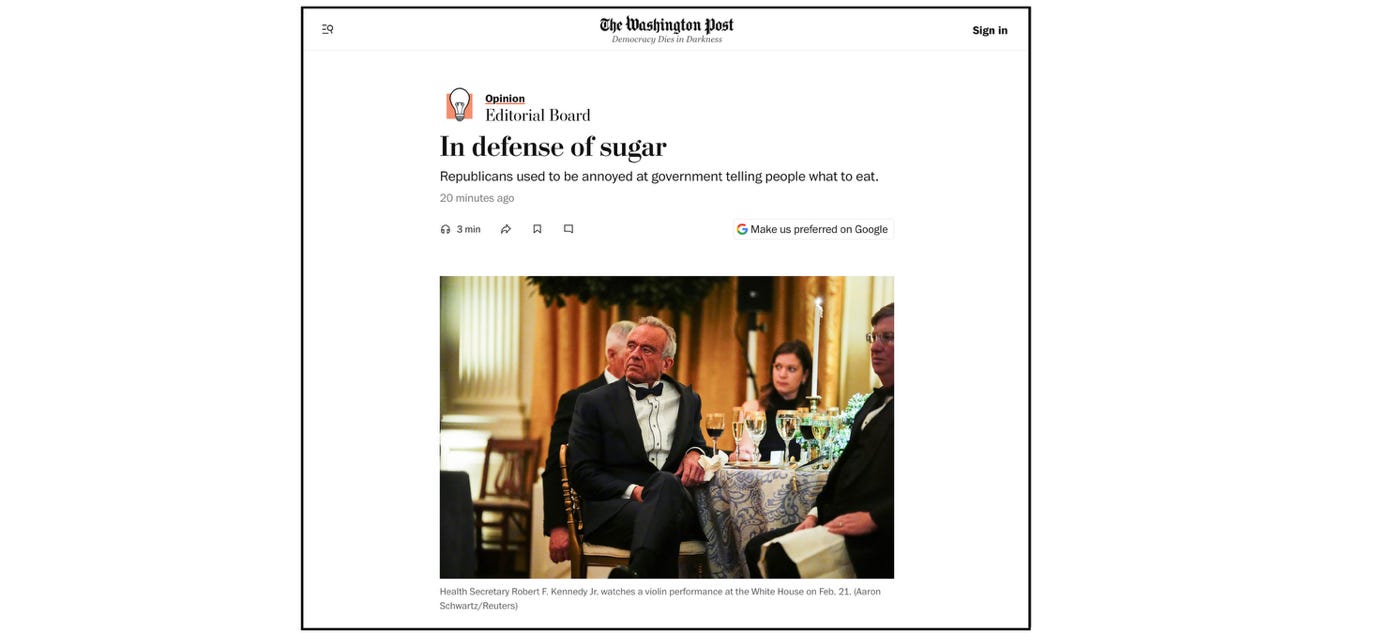
In response, the editorial board of the Washington Post argued that this proposal represents an unacceptable intrusion on consumer freedom, in an article titled “In Defense of Sugar.”
But the issue is not personal freedom. It is industrial manipulation of our food supply with hidden sugar.
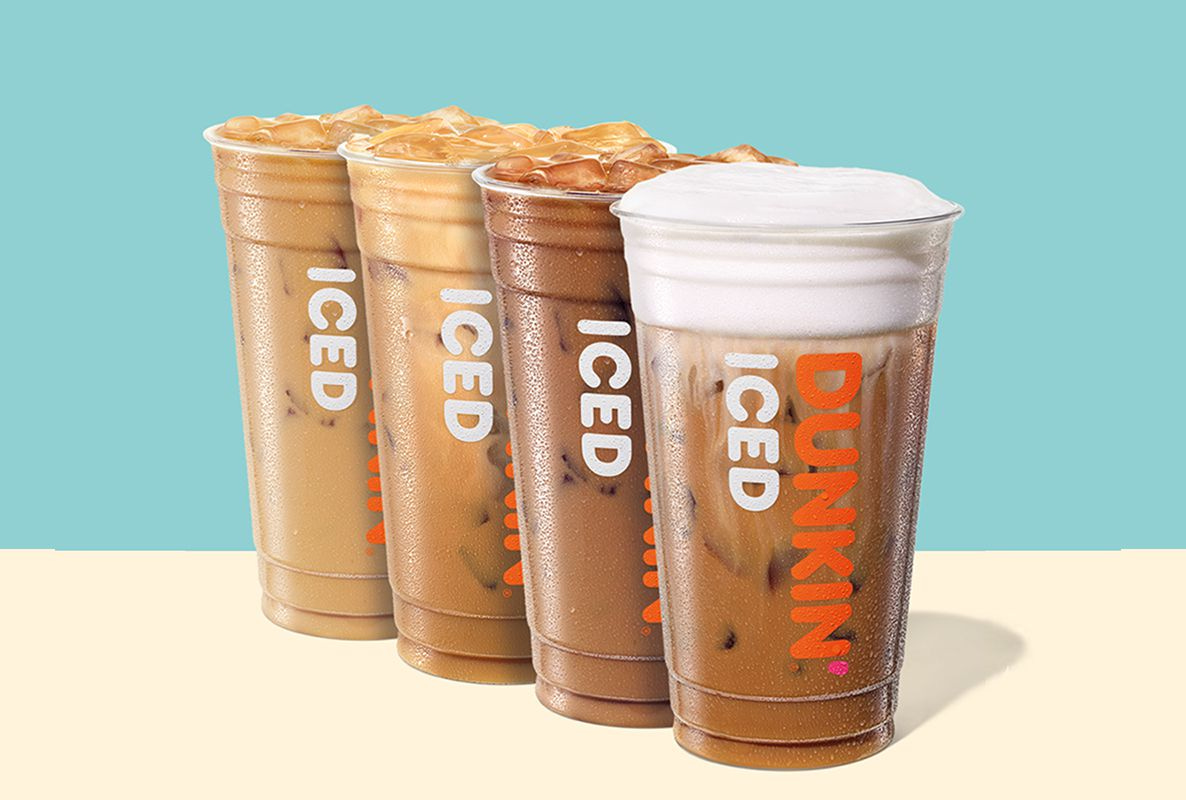
The modern food industry does not simply sell sugar. It engineers it into products in ways that are largely invisible to consumers. Sweetened coffee drinks illustrate the problem clearly.
Some popular versions contain as much as 180 grams of sugar in a single serving — roughly 45 teaspoons. That is about the sugar content of around 17 donuts, delivered in what is marketed as a morning coffee beverage.
No one mistakes a donut for a health food. But a coffee drink is sold as an everyday beverage, often to young consumers who have little reason to suspect they are consuming the sugar equivalent of an entire box of pastries.
That is not a matter of free choice. It is buyer beware in a marketplace designed to obscure what people are actually consuming.
And asking companies to demonstrate safety before selling such products is hardly radical. It is basic consumer protection.
In most areas of public health, manufacturers must show their products are safe before they reach consumers. Pharmaceutical products and medical devices undergo regulatory scrutiny.
But when it comes to food additives and ultra-processed products, the system works very differently.
Under the United States’ “generally recognised as safe” (GRAS) framework, companies are often allowed to declare ingredients safe themselves. Many additives enter the food supply without prior FDA review.
This loophole has allowed thousands of substances to be introduced into processed foods with minimal independent oversight.
Kennedy’s proposal to tighten that system has been portrayed by critics as authoritarian overreach. In reality, it would simply shift the burden of proof back to where it belongs — on the companies profiting from these products.
Ultra-processed drinks loaded with sugar operate in a very different regulatory environment. They are marketed as harmless refreshments while quietly delivering metabolic loads that nutrition scientists have warned about for decades.
The Washington Post’s defence of the sugar industry might be easier to understand if the industry had a history of transparency, but it doesn’t.
In the 1960s, sugar industry groups secretly paid Harvard scientists to publish research minimising sugar’s role in heart disease while shifting blame onto saturated fat. The payments were not disclosed and those papers influenced dietary guidelines for decades.
Internal documents later revealed the strategy plainly: shape the science, redirect the narrative and keep attention away from sugar.
It was a playbook borrowed directly from the tobacco industry.
In that context, the question Kennedy raised — whether companies selling products loaded with sugar should be able to demonstrate safety — does not sound extreme.
Yet even this modest proposal quickly became political.
The governor of Massachusetts — where Dunkin’ is headquartered — weighed in. Governor Maura Healey responded on X with a blunt defence of the company, writing: “Come and take it.”
Kennedy is not proposing to ban sugar or outlaw sweet drinks. He is asking whether companies selling products that deliver extreme quantities of hidden sugar — particularly to adolescents — should be able to demonstrate that those products are safe and transparent about what they contain.
To me, it sounds like a call for better evidence and clearer information.
Consumers cannot exercise meaningful choice if the ingredients and metabolic consequences of products are obscured.
Asking companies to disclose information, demonstrate safety and allow people to make informed decisions is not authoritarian, it’s the foundation of consumer protection.
It is also consistent with Kennedy’s stated mandate to “Make America Healthy Again.”
Under recent US dietary guidance, a meal should contain no more than about 10 grams of added sugar. Yet a single commercial coffee drink can deliver up to 18 times that amount.
More than a third of US teenagers are estimated to have prediabetes, so understanding what people are consuming is a public health necessity.
And yet, in today’s polarised political environment, even that principle can become controversial.
The Washington Post column reads less like a defence of consumer freedom and more like a reflexive attack on anything Kennedy has to say.
If Kennedy suggested that gravity existed, some media outlets might feel compelled to defend levitation.
Which is how a debate about hidden sugar ends with a major newspaper defending the sugar industry rather than the health of our children.


Unless the Democrats get on board with Making America Healthy Again, they will collared with the epidemic of chronic disease! Heck, even former FDA Commission David Kessler was on SIXTY MINUTES in February 2026 expressing support for RFK's policy efforts against ultra-processed foods. In fact, Kessler asserted that ultra-processed foods are even more dangerous than smoking.
If the Democrats want to align themselves with Big Food, Big Agriculture, and Big Pharma, they will bury themselves (early) in their own graves...so says me, a former progressive Democrat, now an Independent.
Follow the money. Who has the most and everything to lose? Healthy humans are not good for profits.