Covid-19 vaccines and questions over miscarriage risk
Pregnant women were given sweeping assurances about Covid vaccine safety. But CDC data were flawed, animal studies raised questions, and officials privately discussed risks they could not rule out.
Newly released text messages recovered from Anthony Fauci’s government phone expose a glaring contradiction at the heart of the Covid-19 vaccine rollout for pregnant women.
In January 2021—mere weeks after emergency authorisations began—Fauci privately raised a concern with then-CDC director Rochelle Walensky and incoming US Surgeon General Vivek Murthy:
“Since many people have significant cytokine storm and fever after the 2nd dose, this theoretically could be associated with miscarriage in the 1st trimester,” he wrote.
Walensky agreed, noting it was “definitely a good point, [especially] after dose two.”
That concern quickly escalated beyond just a theory.
Within weeks, mRNA pioneer Drew Weissman alerted Fauci to data showing that mRNA-LNPs administered to pregnant mice crossed the placenta, reached the foetus, and generated protein that triggered an immune response in the amniotic fluid.
Weissman’s data established a plausible biological mechanism for miscarriage, showing that vaccine components could breach the placental barrier during a critical stage of foetal development.
Subsequent research reinforced those concerns. Studies have since shown that Moderna’s mRNA vaccine crossed the placenta of pregnant mice within an hour, entered the foetal circulation and accumulated in foetal tissue.
But none of this uncertainty ever made it into public messaging.
CDC study built on shaky ground
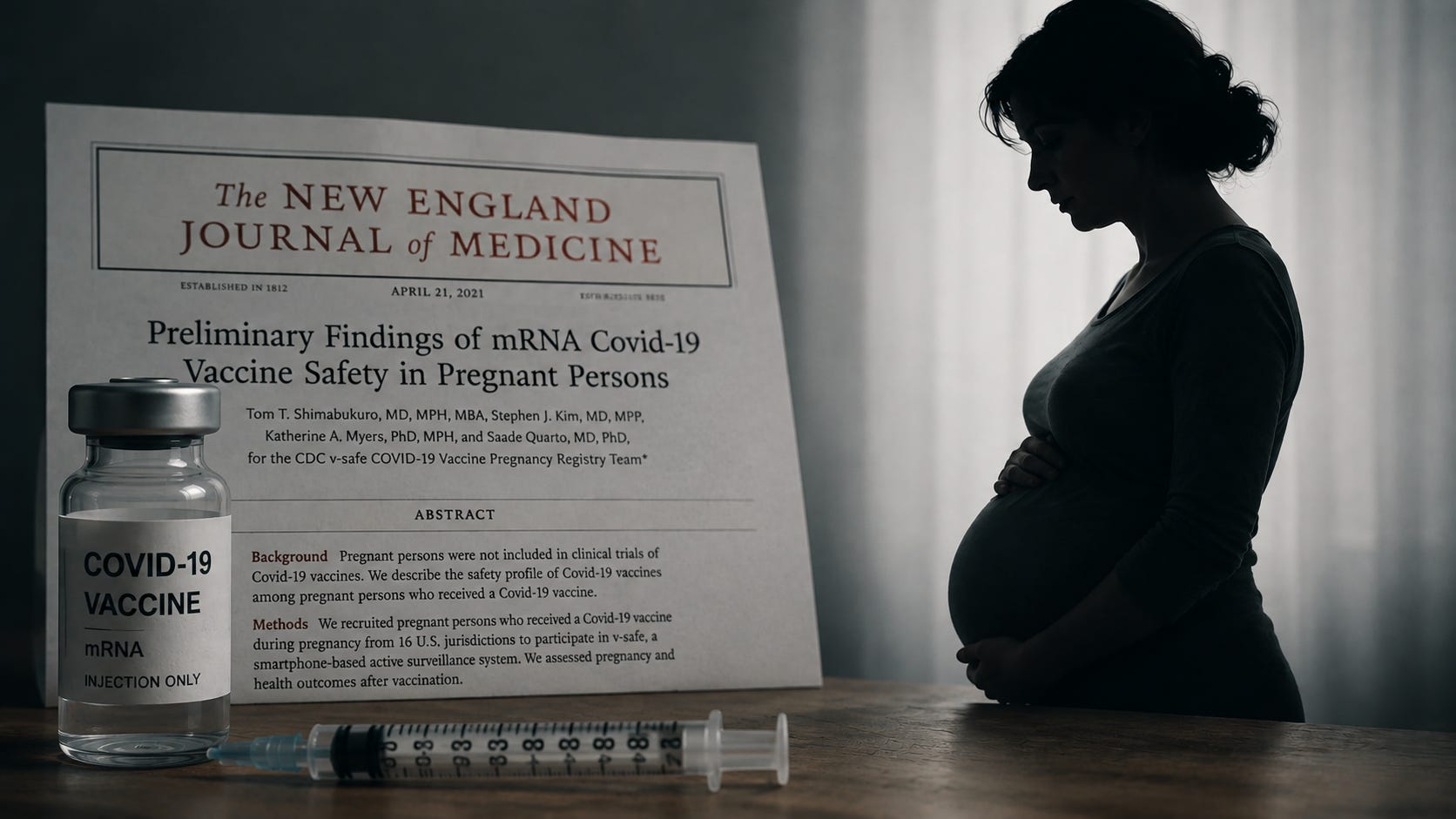
In April 2021, a CDC study led by Tom Shimabukuro was published in The New England Journal of Medicine. Carrying immense authority, it underpinned global assurances that the shots were safe during pregnancy.
Drawing on the agency’s v-safe registry, the paper reported “no obvious safety signals,” citing 104 spontaneous abortions among 827 completed pregnancies—a 12.6% miscarriage rate that appeared to be within normal background risk.
On its face, the paper offered total peace of mind.
But 827 was the wrong denominator: 700 of those women had received their first dose in the third trimester, long after the window for miscarriage—defined as loss before 20 weeks—had closed.
Meanwhile, most women vaccinated around conception or during the first trimester had not been tracked long enough to determine their outcomes.
An accompanying editorial similarly cited the 12.6% figure, framing it as “well within the expected range.”
Months later, however, the journal issued corrections to both the study and the editorial. The 12.6% figure was removed, along with the background comparison.
The correction admitted that “no denominator was available to calculate a risk estimate for spontaneous abortions” due to lack of data.
Ultimately, the foundational study used to reassure pregnant women was incapable of calculating miscarriage risk—but by the time the error was acknowledged, the vaccination campaign was already in full swing.
Dispensing with uncertainty
Mere weeks after privately agreeing with Fauci about theoretical first-trimester risks, Walensky’s agency began aggressively promoting Covid-19 vaccination to pregnant women.
The publication of the Shimabukuro study provided crucial momentum, offering the appearance of solid human evidence.
Medical associations swiftly followed suit.
The American College of Obstetricians and Gynecologists asserted the “known safety” of the vaccines, instructing doctors to “enthusiastically recommend” them and backing workplace mandates.
The Society for Maternal-Fetal Medicine declared: “Vaccination is safe before, during, or after pregnancy.”
By September 2021, Walensky abandoned all nuance.
“There is no bad time to get vaccinated,” she insisted, urging women to take the shot before conception, during pregnancy, or after delivery.
The public pressure worked. CDC estimates showed that by April 2022, nearly 74% of pregnant women in large US healthcare networks had completed a primary series.
The illusion of ‘Big Data’
Even now, critics routinely dismiss any suggestion that miscarriages could be linked to the jabs.
They claim that “huge national-level databases show no impact on miscarriages or newborn health,” and insist that “Big studies show mRNA jabs do not cause miscarriage.”
But big studies are not inherently sound studies.
A database can track millions of pregnancies and still miss critical safety signals if researchers observe women at the wrong gestational stage, compare cohorts with different baseline risks, or suffer from healthy-vaccinee bias.
Pregnancy research is acutely vulnerable to these flaws because miscarriage risk drops sharply with gestational age; a woman vaccinated at 30 weeks cannot experience a first-trimester loss.
Similarly, relying on stable national birth rates as proof of safety is a fallacy.
An elevation in early miscarriages within a narrow gestational window would be heavily diluted across population-wide data rather than triggering an obvious drop in total live births.
Red flags in animal data
Warning signs had already appeared prior to the human rollout.
Pfizer’s animal reproductive-toxicity study documented a pre-implantation loss rate—embryos failing to attach to the uterus—of 9.77% in vaccinated rats, compared with 4.09% in controls. Pfizer dismissed the finding as biologically insignificant.
Additionally, biodistribution studies showed lipid nanoparticles migrated beyond the injection site into reproductive organs, including the ovaries.
These findings warranted rigorous, transparent follow-up rather than sweeping public assurances of safety.
A signal in early pregnancy
Subsequent targeted analyses reinforced concerns over safety.
A large Israeli study of over 226,000 pregnancies led by Guetzkow and colleagues analysed miscarriage risk according to the timing of vaccination.
The clearest signal emerged among women who received their first Covid-19 shot between weeks 8 and 13 of pregnancy.
In this group, the model predicted about 9 losses per 100 pregnancies. Instead, there were 13—roughly 4 additional losses per 100 pregnancies, a concerning increase.
A second CDC analysis of its v-safe registry produced another striking pattern.
Researchers compared seven major birth defects known to originate during early embryonic development, examining women vaccinated before 14 weeks against those vaccinated later in pregnancy.
Every one of the seven defects was more common following early vaccination.
However, the CDC analysed each rare defect separately. Because none individually reached statistical significance, the authors concluded there was “no significant difference” between early and later vaccination.
But the published data allowed six of those defects—measured across the exact same population—to be evaluated together.
When combined, the rate was almost twice as high following early vaccination: 0.94% versus 0.49%, a statistically significant difference.
This calculation shows how data can shift depending on how they are assessed. Examined in isolation, seven rare outcomes lacked statistical power; considered collectively within a single dataset, they raise a clear safety signal.
Observations on the ground
Clinicians on the frontline were also raising alarms.
Obstetrician-gynaecologist Kimberly Biss said that the miscarriage rate in her practice averaged about 4% in 2020, doubled to 8% in 2021, and reached 15–16% in 2022.
“I’d never seen numbers like that in all my years of practice, which began in 1998,” she said in a recent video.
For Biss, rolling out these novel “gene therapies” so rapidly abandoned long-standing obstetric caution and the precautionary principle.
“We never gave anything brand new out of the gate to our pregnant patients,” she said. “Before Covid, that would have been considered malpractice.”
She estimated that roughly 60% of the pregnant women in her practice were Covid-vaccinated, though she could not confirm the vaccination status of every patient who miscarried.
While clinical observations alone cannot establish what caused the surge, she argues that such a dramatic shift within her own practice should have triggered an urgent investigation rather than outright dismissal.
The trial that never answered the question
Pfizer eventually launched a dedicated randomised trial in pregnant women that was supposed to provide the evidence missing from the original rollout.
The company planned to enrol 4,000 women but recruited just 348 before the trial was terminated early. Worse, participants were vaccinated between 24 and 34 weeks gestation, leaving the critical first trimester completely untested.
Despite its small size, the trial also produced a notable numerical imbalance in adverse events of special interest among the infants born, including major congenital anomalies and developmental delays.
These abnormalities occurred in 8 of 156 infants (5.1%) in the vaccine group compared with 2 of 159 (1.3%) in the placebo group.
When the results came before the CDC’s vaccine advisory committee in September 2025, then-chair Martin Kulldorff challenged Pfizer over the imbalance.
He calculated a 4.1-fold higher risk in the vaccine group, with a p-value of 0.049—just crossing the conventional threshold for statistical significance.
Pfizer disputed Kulldorff’s interpretation, arguing that several of the abnormalities arose before vaccination or had alternative explanations. But Kulldorff insisted that the 4-fold imbalance was concerning and warranted further investigation.
A larger trial might have established whether that imbalance was real or simply chance. But that opportunity was lost when the study was terminated early due to poor recruitment.
Rather than closing the evidence gap, the only dedicated randomised pregnancy trial left many with more questions than answers.
An inverted ethical duty
At the core of the pregnancy rollout lies a stark gulf between scientific evidence and public messaging.
The CDC’s foundational study offered false confidence before being quietly corrected, while a dedicated randomised trial in pregnant women was abandoned early.
Rather than acknowledging the limits of the evidence, public health authorities issued absolute claims of “known safety” and maintained there was “no bad time” to get vaccinated.
Pregnant women were owed full transparency about what was known and what remained uncertain. Instead, millions were pushed into making irreversible medical choices, often under strict workplace mandates, on the basis of a false narrative.


Maryanne, Not unexpectedly, the best pithy summary of the facts (which are awful) across the 100 articles on spikeshots/pregnancy I have read over the past few days. Kudos. R
Thanks for the concise history.